A National Vision of a Sustainable Future

Qatar has something every country needs.  I’m not referring to oil or natural gas, although Qatar has both in abundance.  I mean a national vision of and strategy for sustainable development.

Doha skyline

In less than a generation, Qatar has experienced huge economic and social transformation.  The discovery and development of its hydrocarbon resources has fuelled – pardon the pun – Qatar’s economic growth from a small nation dependent on fishing and pearling to one of the highest per capita income countries in the world.

In the face of that rapid expansion, however, new challenges have emerged.  Qataris now need to balance modernization with the preservation of values and traditions, a priority in a country where 80% of the people are expatriates.  They must also figure out – as we all must – how to achieve economic and social equity for present and future generations while protecting environmental health.

Recognizing these challenges, Qatar embarked on an initiative to define the characteristics of the country’s future.  The State established the General Secretariat for Development Planning, which undertook multi-stakeholder consultation across Qatar.  The Qatar National Vision 2030 is the product of that initiative. Click here to read on about the key elements of Qatar’s sustainable future!

Too Little for Too Long

At the end of September, the Institute of International Finance held its annual meeting in Washington.  The IIF is a global association of financial institutions, whose mission is to “support the financial industry in prudently managing risks, including sovereign risk; in developing best practices and standards; and in advocating regulatory, financial, and economic policies that are in the broad interest of [its] members and foster global financial stability.”

Prominent on the agenda was international financial regulatory reform, over which considerable debate is ongoing. On the one hand, the G20 plan tougher financial regulatory requirements.  The IIF, on the other hand, while acknowledging the need for reform, calls for a cautious approach, arguing that stricter rules could compromise a fragile economic recovery.  In his speech to the IIF’s annual meeting, Bank of Canada Governor Mark Carney was critical of the IFF’s position, in part because it fails to assume any economic benefit from reducing the risk of future financial crises and because banks already have until 2019 to adapt to the changes. The contrasting viewpoints are summarized succinctly in this Globe and Mail article by Kevin Carmichael, titled “Carney, Waugh spar over new banking rules” (September 26, 2011).

Bank of Canada Governor Mark Carney

What jumped out at me from Mr. Carney’s remarks is this gem of a quote:  “If some institutions feel pressure today, it is because they have done too little for too long, rather than because they are being asked to do too much, too soon.

This statement reflects the reality that increasing demands for transparency, accountability, ethical behaviour, and consideration of non-financial material issues (like environmental, social, and governance issues) have been apparent for some time, and there is diminishing justification – and tolerance – for delayed action.  This is relevant not only to financial institutions, but to other corporate sectors as well.

The pressure to which Mr. Carney alluded will only increase with prolonged inaction, as the gap between corporate behaviour and performance and emerging stakeholder expectations and regulatory requirements continues to grow.


Click here for Governor Mark Carney’s full remarks to the IIF.

Click here to link to the IIF’s paper, “The Cumulative Impact on the Global Economy of Changes in the Financial Regulatory Framework” (September 2011).

Click here to link to the IIF’s latest paper on cumulative economic impact of regulatory reform, addressing revisions (October 2011).

The Changing Currency of a Modern Licence to Operate

Following up on my prior writing and speaking engagements on the topic of social media and corporate responsibility, the Canadian Institute of Mining, Metallurgy and Petroleum asked me to write a piece for their journal, CIM Magazine, focused on the extractive sector.
An edited version of what I wrote appears in the September/October issue here.
I was also asked to write a sidebar piece highlighting Suncor‘s social media experience that I referenced in the main story. The sidebar piece, entitled “Going Where the Conversations Are“, appears after the main story at the link above.
Comments welcome on either piece; click on the “Write Comment” option in the menu on the left side of this page.

Canada’s Sustainability Heroes: the Clean 50

Earlier this month, Delta Management announced the inaugural Clean 50, a group of committed individuals who have made significant contributions to sustainability or “clean capitalism” in Canada in recent years.  These 50, either individually or, often, as leaders of a team, have been unrelenting advocates for sustainability in their organizations, their sectors, and their communities, collectively elevating the level of dialogue in Canada around environmental and social performance and innovation.  This group of talented and inspiring leaders epitomizes the drive and dedication that characterizes the sustainability field in Canada today.  And so it was with enthusiasm and excitement that I took part in the Clean 50 Summit held this week in Toronto. Read more about moving from ideas to action

The Red Flag over Playmobil’s Castle

My daughter loves Playmobil.  She spends hours constructing and then animating complex scenes and she’s a master at combining parts from different sets to create new structures that aren’t in the well-thumbed Playmobil catalogue.  Except for the unpleasantness of stepping on a rogue piece in the dark or sifting through the dust of the vacuum cleaner bag to recover some special plastic bit, I quite like the stuff myself.  It’s the sort of toy I wish I had when I was a kid.

However, I must admit I’m disappointed by the company’s apparent inattention to sustainability.

A set my daughter bought was missing a piece – a rare occurrence – so I ordered a replacement part through the company’s website.   Here’s what I received in the mail a couple of weeks later:

The piece
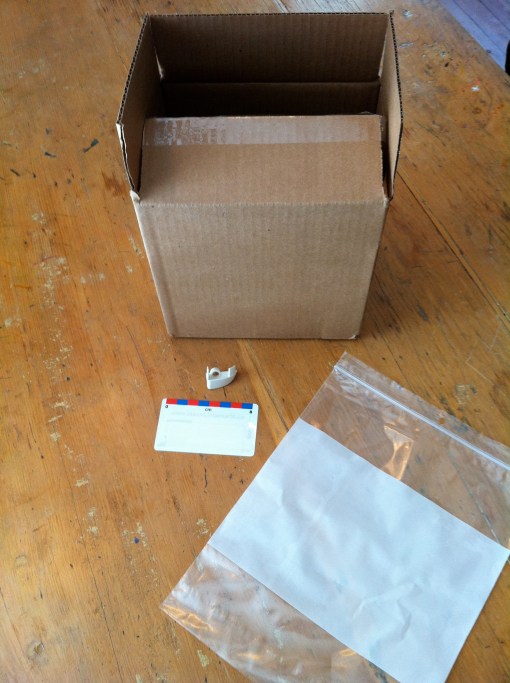
The packaging

The piece itself is about 3 x 2 x 2 cm!  You could fit  hundreds of them in that box!  (At least the box was not also filled with those hard-to-recycle (and annoyingly clingy) styrofoam chips.)

This experience prompted me to go to Playmobil’s website to find out where they stand on sustainable packaging.  Much to my chagrin, I was unable to find any information about any aspect of sustainability at Playmobil and its maker, Geobra Brandstätter gmbH.

I went out to the shed to check the original packaging; a few boxes have Der Grüne Punkt, indicating the company participates in the Green Dot program in Germany, but there is no other mark to indicate recycled content or recyclability of the packaging.

There are so many resources out there now to support manufacturers in adopting sustainable packaging materials and systems, there really is no excuse for a consumer products manufacturer to ignore this aspect of corporate responsibility.  For example, the Sustainable Packaging Coalition is an industry working group that offers courses, briefs, design guidelines and other resources for sustainable packaging.  The Sustainable Packaging Alliance provides tools and delivers workshops and events.  Or check out the annual Sustainable Packaging Forum, coming up in September in Texas.

Sustainable packaging minimizes material waste, both in manufacturing and end-of-use disposal.  It also reduces energy and emissions associated with transportation from factory to distribution centre to retail store.  And, of course, it saves money in material costs, transportation, and warehousing.

Playmobil red flagAny way you look at it, the clearly unsustainable packaging used to send me this replacement part is a red flag.  It shows that Playmobil either isn’t doing anything about sustainable packaging or, if it is, the company has overlooked certain customer transactions that involve packaging.

That there is no publicly available information about Playmobil’s corporate responsibility programs, too, is a red flag.  Does it mean that Playmobil and Geobra are doing nothing about sustainability?  Or does it mean, simply, they aren’t communicating what they’re doing?  Either way, it’s leaving me and every other interested consumer in the dark.  And that’s no way to build confidence and trust.

Click here to access Playmobil’s Facts and Figures page (over 2 billion figures manufactured to date!)

Image of Playmobil part from this eBay listing.